Wedge-welding methods

Conventional Wedge Welding and the BPR Method

Most of the wedge-welding industry is familiar with one conventional machine arrangement. Base pressure roller, or BPR, wedge welding uses a different wedge-and-pressure configuration that supports handheld production welding, wheel-mounted systems, automation, and specialized machinery.

Because the opposing-roller configuration dominates the established market, it is usually called simply wedge welding. Most operators and buyers have no reason to use a separate abbreviation for it.

For a precise technical comparison, the familiar arrangement may be described as an opposing pressure roller configuration. The term is useful only when distinguishing it from BPR; it should not be treated as common buyer terminology.

Conventional opposing-roller wedge welding

A heated wedge enters between overlapping thermoplastic layers. As the machine travels, or as the material moves through the machine, the wedge heats the intended joining surfaces. Immediately behind the wedge, opposing rollers compress the heated layers and form the seam.

This arrangement is well suited to continuous welding where the material can be guided consistently through the wedge-and-roller path.

Typical machine forms include wheel-mounted field welders, table-mounted production machines, traveling systems, and stationary machines through which material is fed.

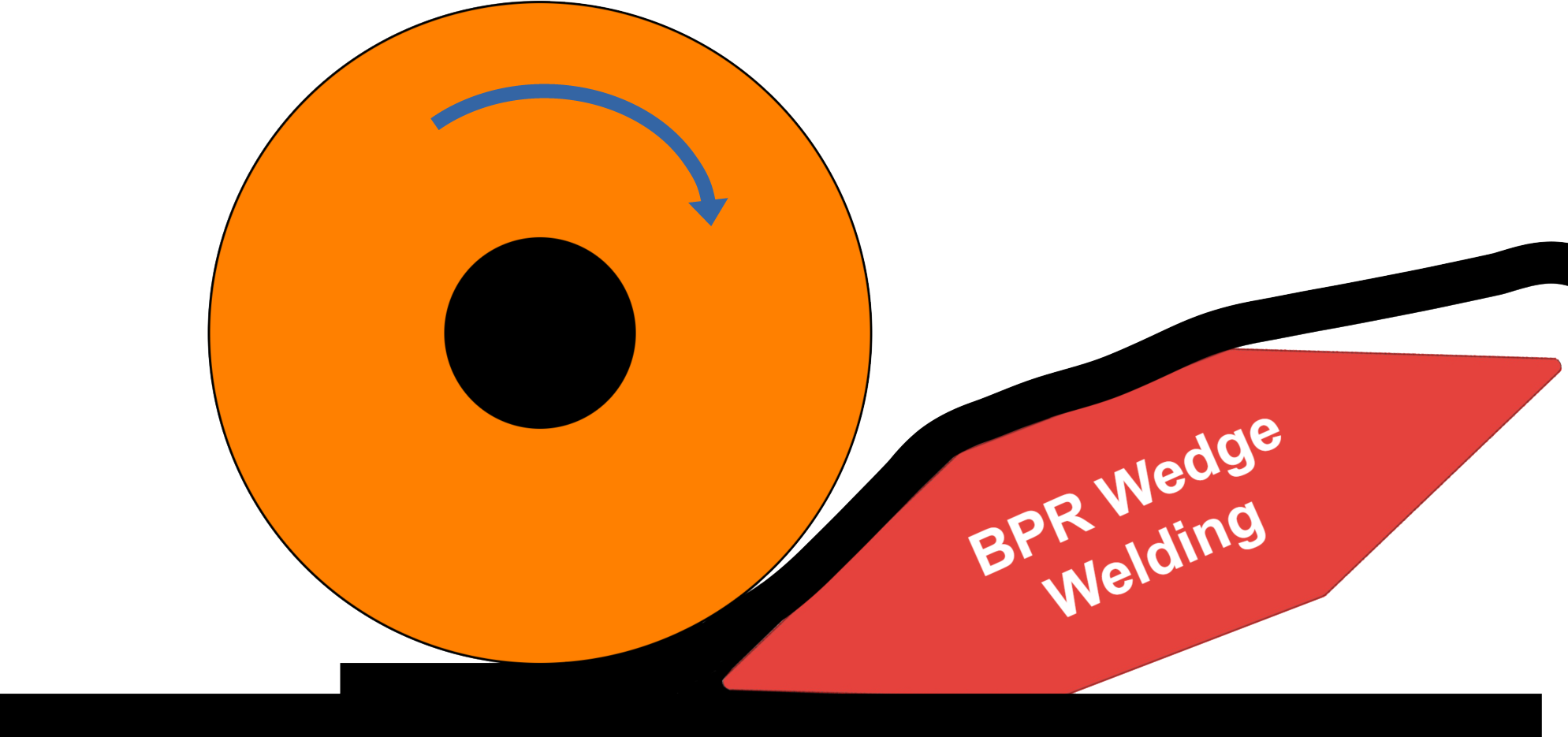
Simplified BPR wedge-welding diagram showing a rotating pressure roller, overlapping material, heated wedge, and supporting base
Simplified BPR arrangement. The wedge travels between overlapping material layers while the pressure roller consolidates the seam against a supporting base.

Base pressure roller wedge welding

BPR changes the relationship between the wedge, pressure roller, material, and supporting base. This allows the wedge-and-pressure system to be configured in machine forms that differ from the familiar opposing-roller arrangement.

In its simplest complete configuration, BPR is a handheld device: the Novaseal® GT-100 BPR Handheld Wedge Welder.

When the method is used in a GT-200 or another customized application, the wedge is configured directly as a BPR system. The machine does not retain a handheld housing or handle unless manual operation is part of the required form factor.

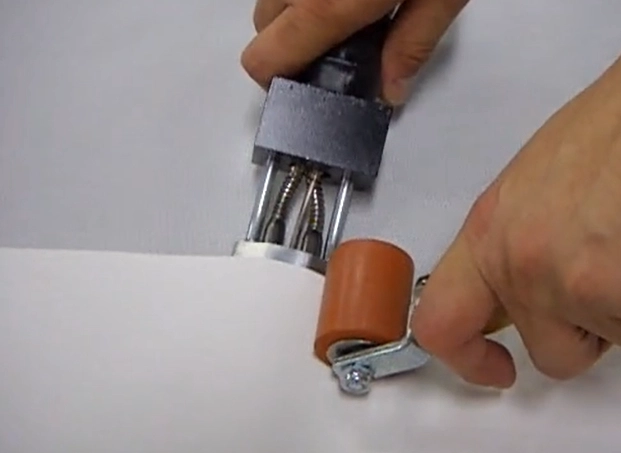
GT-100 BPR wedge welding close-up on overlapping vinyl material
Handheld BPR wedge welding on vinyl. The heated wedge is positioned between the overlapping layers while the roller applies consolidation pressure against the supported material.
Simplest configuration

Handheld BPR

The GT-100 is a complete production-capable BPR wedge welder. It is used for repetitive fabrication, roofing, production work, tight-access seams, repair, patchwork, and other applications suited to manual guidance.

Review the GT-100 handheld BPR configuration.

Availability: Manufactured with limited inventory; typical delivery is approximately 2–4 weeks, subject to current availability and production scheduling.

Wheel-mounted configuration

GT-200 BPR system

The GT-200 is a purpose-built wheel-mounted BPR machine used predominantly with nonwoven fabrics and related materials where welding is best accomplished by pushing the wedge through the material assembly.

Availability: Manufactured on a made-to-order basis.

Application-specific configuration

Custom BPR systems

Nova Products Mfg., Inc. has developed custom BPR solutions for roofing, production-line welding, automation, specialized material handling, and other unique machine requirements.

Availability: Engineered and manufactured to order according to the application.

Directional silver wedges and omnidirectional Ni-200 wedges

Both conventional and BPR systems use highly conductive wedge materials, but their typical wedge size, material, geometry, and directional behavior differ.

Conventional wedge welding

Smaller silver wedge

Conventional opposing-roller machines typically use a smaller wedge made of silver. The wedge is formed directionally, with its geometry intended for travel in a defined direction. Under heavy production use, a silver wedge can wear and may require periodic replacement.

Typical material
Silver
Typical size
Smaller wedge
Directionality
Directional
Thermal behavior
Excellent thermal conductivity
Service life
May require replacement under heavy use
BPR wedge welding

Larger Ni-200 wedge

BPR systems typically use a larger Ni-200 nickel wedge. The wedge is omnidirectional and can be used in either direction, supporting the operating flexibility of handheld and purpose-built BPR configurations. Ni-200 is mechanically stronger and more durable than silver in this application, with excellent resistance to corrosion and service wear. Based on Nova Products Mfg., Inc. operating experience, a Ni-200 wedge may provide substantially longer service life and may last for the useful life of the equipment when it is not damaged or misused.

Typical material
Ni-200 nickel
Typical size
Larger wedge
Directionality
Omnidirectional
Thermal behavior
Excellent thermal conductivity
Durability
Corrosion-resistant and highly wear-resistant
Service life
Potentially equipment-life service, depending on use

Handheld does not mean occasional-use

The handheld BPR configuration is often used for production work. Its compact form can make it the primary welding method where the operator must follow a product contour, work in a restricted area, process short or accessible continuous seams, or bring the wedge to the product rather than feeding the product through a larger machine.

Repair and patchwork are legitimate uses, but they do not define the GT-100 or the BPR method. The same core wedge-and-pressure principle can be engineered into production-line, roofing, automated, wheel-mounted, and other specialized systems.

Repetitive industrial fabrication Roofing products and membranes Production-line integration Short and continuous seams Complex assemblies Tight-access production areas Repair and patchwork Custom automation and form factors

Practical differences between the two arrangements

Neither arrangement is universally preferable. Selection depends on the complete material, seam geometry, material path, production method, accessibility, travel direction, and required seam performance.

Consideration Conventional wedge welding BPR wedge welding
Industry familiarity The established configuration most buyers know simply as wedge welding Less familiar and normally requires explanation
Pressure arrangement Opposing pressure rollers Pressure against a supporting base or configured support
Typical wedge Smaller directional silver wedge Larger omnidirectional Ni-200 wedge
Simplest machine form Continuous traveling or material-fed machine Handheld wedge welder
Other machine forms Field, table-mounted, stationary, traveling, and automated systems Wheel-mounted, automated, production-line, and application-specific systems
Patchwork Not positioned as a patchwork method Possible with a suitable handheld BPR configuration
T-joints and layered intersections Cannot form a T-joint that requires the machine to cross an existing welded overlap because the layered intersection cannot pass through the opposing pressure rollers. A suitable BPR configuration, including the GT-200, can cross an existing two-layer seam and weld a perpendicular third length to form a T-joint.
Direction of operation Typically follows the directional wedge geometry Omnidirectional wedge supports operation in either direction
Custom integration Available in appropriate conventional machinery Wedge can be configured directly into a purpose-built BPR system

Material testing remains essential

For both methods, weldability depends on the complete material composition and layer structure, including coating or film chemistry, reinforcement, thickness, surface treatment, printing, wedge temperature, pressure, travel speed, and required seam performance. Review the materials and weldability guide.

Compare wedge welding with hot air, RF, impulse, and Packet Welding.

Discuss a standard or custom BPR application

Novaseal® GT-100 and GT-200 wedge welders are manufactured and supported by Nova Products Mfg., Inc. Application evaluation, manuals, parts, service, and custom BPR system development remain available.

Explore Novaseal® wedge welders