Integrated BPR configuration for nonwoven textiles

GT-200 Integrated BPR Wedge-Welding System

The Novaseal® GT-200 is an application-specific integrated BPR wedge-welding system engineered for compatible nonwoven textile materials. Wheel-mounted walk-behind machines are one GT-200 implementation, not the definition of the system.

The GT-200 is not a handheld GT-100 placed inside a larger frame. Its wedge, pressure support, movement, material handling, controls, and machine structure are configured directly as one integrated BPR system.

Every GT-200 begins with the nonwoven textile application. Seam geometry, support, workflow, field conditions, and production objectives determine the final configuration.

An integrated BPR system built around the nonwoven material path

The GT-200 is designed so the integrated system can be guided along an overlapping nonwoven textile assembly while the wedge heats the intended bond surfaces and the BPR arrangement applies pressure against the required supporting base.

In a wheel-mounted walk-behind implementation, pushing the wedge through the material can provide the preferred relationship among machine travel, material support, overlap control, and operator guidance.

This does not mean that every nonwoven textile or field application should use the same machine form or operating direction. The complete material construction, seam, support, workflow, and production requirement must be evaluated.

Integrated application-specific architecture Wheel-mounted walk-behind form available BPR wedge-and-pressure arrangement Machine configured for pushing the wedge Application-specific speed and temperature settings Made-to-order manufacturing

Nonwoven textile and geotextile field welding

The GT-200 is engineered specifically for compatible nonwoven textile materials. A wheel-mounted implementation can push the wedge through the supported overlap and can cross an existing welded seam to form a T-joint.

Compatible nonwoven textiles

Compatible nonwoven textile constructions may require an integrated arrangement that supports the material while controlling wedge travel and pressure along the overlap.

  • Application-specific nonwoven constructions
  • Continuous overlapping seams
  • Field or production-area movement
  • Material support matched to the assembly
Geotextile applications

A wheel-mounted GT-200 can be evaluated for compatible nonwoven geotextile applications where the machine geometry and travel direction fit the seam and installation method.

  • Geotextile assemblies
  • Compatible nonwoven textile constructions
  • Field installation and fabrication
  • Made-to-order machine configuration

Specialized field applications

The GT-200 format may also be relevant where material remains substantially supported while the operator guides a purpose-built machine along the required seam path.

  • Long or repeated field seams
  • Products difficult to feed through stationary equipment
  • Applications requiring controlled machine travel
  • Application-specific guides or supports

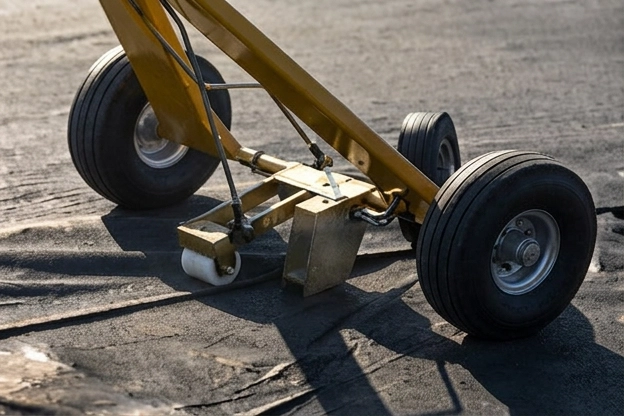
GT-200 wedge, roller, and seam path in nonwoven geotextile

These operating views show the purpose-built GT-200 moving over supported nonwoven geotextile while its wedge and BPR pressure arrangement remain integrated into the wheel-mounted machine.

GT-200 wheel-mounted BPR wedge welder operating on nonwoven geotextile in a landfill installation
GT-200 operating on supported nonwoven geotextile in a landfill application. The wedge and pressure system are integrated directly into this walk-behind GT-200 configuration.
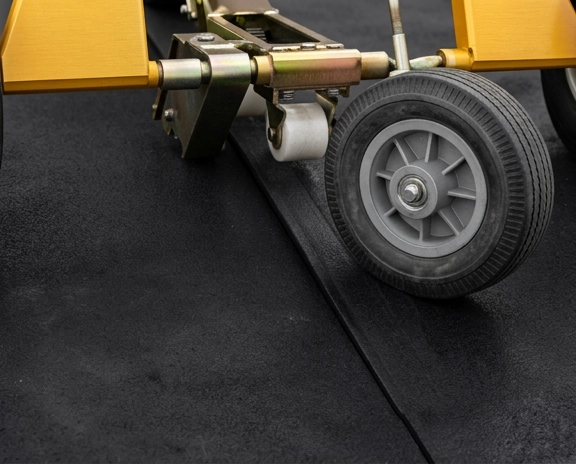
Front close-up of the GT-200 pressure roller and geotextile overlap seam
Front operating detail showing the GT-200 pressure roller, wheel path, and overlapping geotextile seam.

Welding across existing seams and forming T-joints

A T-joint begins with two geotextile lengths welded side by side. A third length is then positioned perpendicular to the first two. Completing the joint requires the welder to cross the existing two-layer seam and continue welding the perpendicular length over the layered intersection.

Conventional opposing-roller wedge welding cannot make this T-joint because the multi-layer intersection cannot pass between the opposing pressure rollers. The GT-200 BPR arrangement applies pressure against the supporting base, allowing the machine to travel across the existing seam and complete the perpendicular weld.

First two lengths welded side by side Third length positioned perpendicular GT-200 crosses the existing two-layer seam Perpendicular weld completed over the layered intersection

The GT-200 is the integrated BPR system for nonwoven textiles

BPR describes the wedge-and-pressure architecture. The GT-100 is the purpose-built handheld implementation. The GT-200 applies BPR through an integrated system engineered specifically for compatible nonwoven textile materials. Other GT systems serve different material and process requirements.

01

GT-100 handheld configuration

The simplest complete BPR configuration. It is often used directly for production work, roofing, complex assemblies, repair, patchwork, and limited-access applications.

Review the GT-100 handheld BPR wedge welder

03

Other application-specific GT systems

Integrated systems for HDPE geomembranes, vinyls, and other heavier heat-weldable plastics may incorporate laser guidance, split-wedge pressure-verification channels, custom movement, controls, tooling, and material handling.

What must be evaluated before specifying a GT-200 system

A machine classification alone does not establish weldability or production suitability. The material, seam, operating surface, travel path, and required result must be considered together.

1

Material composition and layer structure

Confirm the complete thermoplastic composition, nonwoven structure, coatings, films, reinforcement, thickness, surface treatment, and layer count.

2

Seam and overlap

Define overlap width, seam path, access, required welded width, edge condition, and whether the machine can remain properly aligned.

3

Support and operating surface

Determine how the material will be supported and how the BPR pressure arrangement will react against the underlying surface during travel.

4

Temperature, speed, and pressure

Establish settings that create the required bond without unnecessary surface damage, distortion, or insufficient interface heating.

5

Production and field conditions

Consider operator control, travel consistency, environmental conditions, repeated seam requirements, handling, and inspection criteria.

GT-200 is specific to nonwoven textiles; other GT systems serve heavier plastics

The GT-200 is the integrated GT configuration developed for compatible nonwoven textile materials. It should not be presented as the integrated platform for HDPE, vinyls, or other heavier heat-weldable plastics.

Other GT systems have been developed for those heavier materials and for applications requiring different wedge geometry, guidance, pressure verification, material handling, movement, controls, or production-line interfaces.

All integrated GT systems are engineered and manufactured on a made-to-order basis by Nova Products Mfg., Inc.

HDPE geomembranes and heavier plastics Vinyl and other heat-weldable materials Laser-guided seam tracking Split-wedge dual seams Pressure-verification air channels Application-specific material handling Custom controls and tooling Production-line integration

Made-to-order GT-200 systems

Novaseal® GT-200 BPR wedge welders are manufactured on a made-to-order basis by Nova Products Mfg., Inc.

Manuals, parts, service, application evaluation, and technical support remain available. Existing manuals may be revised in the future as product documentation is updated.

GT-200 and field-welding questions

Is the GT-200 a handheld wedge welder mounted on wheels?

No. The GT-200 is an integrated BPR wedge-welding system engineered for compatible nonwoven textile materials. A wheel-mounted walk-behind machine is one implementation.

What materials is the GT-200 designed to weld?

The GT-200 is designed specifically for compatible nonwoven textile materials, including appropriate nonwoven geotextile constructions. It is not the integrated GT configuration for HDPE, vinyls, or other heavier heat-weldable plastics.

Does every nonwoven material weld successfully?

No. Suitability depends on the complete material composition and layer structure, process settings, support, seam design, and required performance.

Is the GT-200 stocked?

No. GT-200 systems are manufactured on a made-to-order basis.

Can the GT-200 weld a T-joint?

Yes. The GT-200 can cross an existing two-layer geotextile seam and weld a third length positioned perpendicular to it. Conventional opposing-roller wedge welding cannot make this joint because the layered intersection cannot pass between the opposing rollers.

Evaluate an integrated nonwoven textile application

Nova Products Mfg., Inc. manufactures and supports Novaseal® GT-200 systems for compatible nonwoven textile materials and evaluates other integrated GT configurations for different materials and process requirements.

View the Novaseal® GT-200 product page