Material compatibility

Wedge-Welding Materials and Weldability

Wedge welding requires compatible thermoplastic joining surfaces and a material assembly that can be heated, compressed, and stabilized within a workable process window. Polymer name alone does not determine whether a production seam will succeed.

In wedge welding, the heated wedge contacts the facing surfaces inside an overlap. Those surfaces must soften or fuse under the selected heat-and-pressure conditions while the surrounding material remains usable and dimensionally acceptable.

A material may be described broadly as vinyl, polyethylene, polypropylene, polyurethane, a thermoplastic laminate, or a coated fabric, yet two products within the same general family can behave differently. Formulation, coating thickness, reinforcement, additives, surface treatment, printing, age, and construction can change the usable welding window.
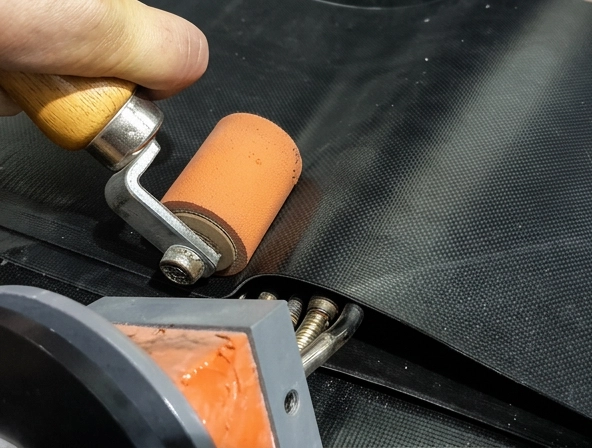
Flexible constructions commonly evaluated for wedge welding

These categories describe material forms that may be compatible with wedge welding. They are not universal guarantees for every product within the category.

01

Films and membranes

Flexible thermoplastic sheet materials may be welded when the facing surfaces have a suitable softening range and can be pressed together without unacceptable distortion.

  • Industrial films
  • Roofing membranes
  • Geomembranes and liners
  • Flexible sheet products
02

Coated and laminated fabrics

The weld normally depends on the coating or film at the joining interface. The carrier fabric, reinforcement, coating weight, and total thickness can affect heat flow and pressure response.

  • Vinyl- or thermoplastic-coated fabrics
  • Industrial flexible composites
  • Multilayer laminates
  • Reinforced sheet materials
03

Nonwoven materials

Nonwovens require attention to fiber composition, bonding method, loft, compressibility, and material handling. Some applications are better processed by pushing a BPR wedge through the assembly.

  • Thermoplastic nonwovens
  • Geotextiles and related materials
  • Layered or reinforced nonwovens
  • Application-specific industrial fabrics
04

Printed and surface-treated materials

Printing, topcoats, release treatments, primers, and decorative layers can change surface response or create marking concerns. The actual joining interface must remain heat-sealable.

05

Multilayer assemblies

Different layers may soften at different rates. The intended bond interface must receive enough heat while outer surfaces, reinforcements, and internal layers remain within acceptable limits.

06

Existing or weathered material

Repairs may involve contamination, oxidation, plasticizer change, surface wear, coatings, or environmental exposure. Cleaning and test welding may be necessary before production work.

Different weights, thicknesses, and compatible dissimilar materials

The GT-100 can weld different material thicknesses and weights without modification to its basic machine configuration. Temperature, travel speed, pressure, support, and operator technique are adjusted to the actual construction. Dissimilar materials can also be sealed when the intended joining surfaces are thermoplastically compatible and the process is validated.

GT-100 welding an overlapping heavy vinyl construction
GT-100 welding a heavy vinyl construction. Material weight and thickness are addressed through process settings rather than modification of the basic machine configuration.
GT-100 sealing dissimilar flexible materials at an overlapping seam
GT-100 sealing dissimilar materials. The actual contacting thermoplastic surfaces and the complete process window must be compatible with the required seam.

What determines whether a material can be wedge welded?

Weldability is the combined result of material behavior, seam design, process settings, machine configuration, and the performance expected from the finished seam.

Joining-surface chemistry

The exact film or coating at the overlap must respond to heat and pressure. Resin blend, additives, plasticizers, fillers, and coating formulation can change the welding range.

Layer structure

Base fabric, reinforcement, coating thickness, film gauge, layer count, and total construction thickness affect heat transfer, compression, and seam formation.

Surface condition

Printing, lacquer, treatment, release chemistry, dirt, moisture, oil, aging, and weather exposure can interfere with bonding or alter appearance.

Thermal process window

Wedge temperature and travel speed determine how much heat reaches the interface. The usable range must be wide enough to form a seam without damaging the material.

Pressure and support

Roller pressure, roller geometry, base support, overlap control, and material guidance influence contact and consolidation immediately after the wedge.

Required seam performance

A visually closed seam may not satisfy peel, shear, leak, dimensional, appearance, or service-environment requirements. Acceptance criteria must be defined before settings are finalized.

Temperature, speed, and pressure must be developed together

A setting cannot be judged in isolation. Changing travel speed changes heating time; changing pressure changes consolidation; changing material thickness or support can require a different operating window.

Insufficient energy or pressure

Incomplete seam formation

The joining surfaces may not soften adequately, wet together, or remain in sufficient contact. The seam may appear intermittent, weak, or easily separated.

Controlled process window

Stable fusion and consolidation

The interface receives enough heat and pressure to form the required seam while surface condition, dimensions, and surrounding layers remain acceptable.

Excessive energy or pressure

Distortion or material damage

Excessive heat, slow travel, or inappropriate pressure can cause marking, thinning, squeeze-out, shrinkage, deformation, coating damage, or reinforcement exposure.

Wedge geometry also matters

Conventional systems typically use a smaller directional silver wedge, while BPR systems typically use a larger omnidirectional Ni-200 wedge. Both offer excellent thermal conductivity, but the Ni-200 wedge is mechanically stronger, corrosion-resistant, and substantially more durable under heavy service. Silver wedges may require replacement with extensive use, while a properly used Ni-200 wedge may provide equipment-life service. Their geometry and machine arrangement also influence material contact and operating direction. Review the wedge-design comparison.

Material compatibility is only part of method selection

A material may be heat-sealable by more than one wedge-welding arrangement. The preferred configuration can depend on how the product must be supported, moved, accessed, and guided during welding.

Conventional wedge welding

The material follows a defined path around the wedge and through opposing pressure rollers. This arrangement is commonly used for continuous seams where the overlap can be guided consistently.

  • Predictable continuous material path
  • Traveling or material-fed machines
  • Directional wedge geometry is typical
  • Material must pass through the roller arrangement

BPR wedge welding

The material is welded against a base or configured support. In its simplest form, BPR is handheld; in GT-200 and custom systems, the wedge is configured directly into the required machine architecture.

  • Handheld production and access work
  • Wheel-mounted systems for selected nonwovens
  • Operation in either direction with the omnidirectional wedge
  • Custom production-line, roofing, and automated forms

The machine arrangement does not make an incompatible material compatible. It changes how the material is heated, supported, pressured, moved, and accessed.

When wedge-welding testing is required

Testing is appropriate whenever the material, seam, production method, or performance requirement is not already established. It is especially important when a supplier changes a formulation or coating, because the general product name may remain unchanged while welding behavior changes.

For custom machinery, testing should precede final machine architecture whenever practical. The material-handling method, wedge orientation, speed range, pressure system, seam width, and support can then be developed around the actual application.

1

Define the construction

Identify the exact material, joining surfaces, thickness, reinforcement, overlap, seam geometry, and intended service conditions.

2

Develop a starting window

Select an appropriate wedge configuration and establish controlled starting ranges for temperature, travel speed, pressure, and support.

3

Produce and inspect samples

Evaluate seam continuity, appearance, marking, distortion, interface development, and repeatability across the intended operating direction.

4

Test against requirements

Use the application’s actual acceptance criteria, which may include peel, shear, leak, dimensional, visual, environmental, or production-rate requirements.

5

Record the production method

Document the material identity, machine configuration, settings, operator method, seam geometry, and accepted test results for repeatable production.

Wedge-welding material questions

What materials can be wedge welded?

Compatible thermoplastic films, membranes, coated fabrics, nonwovens, laminates, roofing materials, geosynthetics, and other flexible constructions may be suitable. The actual joining surfaces and full construction must be evaluated.

Can the polymer name determine compatibility?

No. Polymer family is only a starting point. Formulation, coatings, reinforcements, thickness, additives, surface treatment, printing, condition, and performance requirements can change the result.

Does BPR weld materials that conventional wedge welders cannot?

The two arrangements can overlap in material capability. BPR may solve handling, access, travel-direction, support, or form-factor problems, but the material still needs a compatible heat-sealable interface.

Can printed or coated fabrics be wedge welded?

Some can. The joining interface must remain weldable, and testing should evaluate marking, topcoat or ink response, heat exposure, and seam performance.

Discuss a wedge-welding material or production requirement

Nova Products Mfg., Inc. manufactures and supports Novaseal® BPR wedge-welding systems and evaluates standard and custom applications. Material samples, seam requirements, production method, and intended machine form should be reviewed together.

Contact Novaseal® about wedge welding